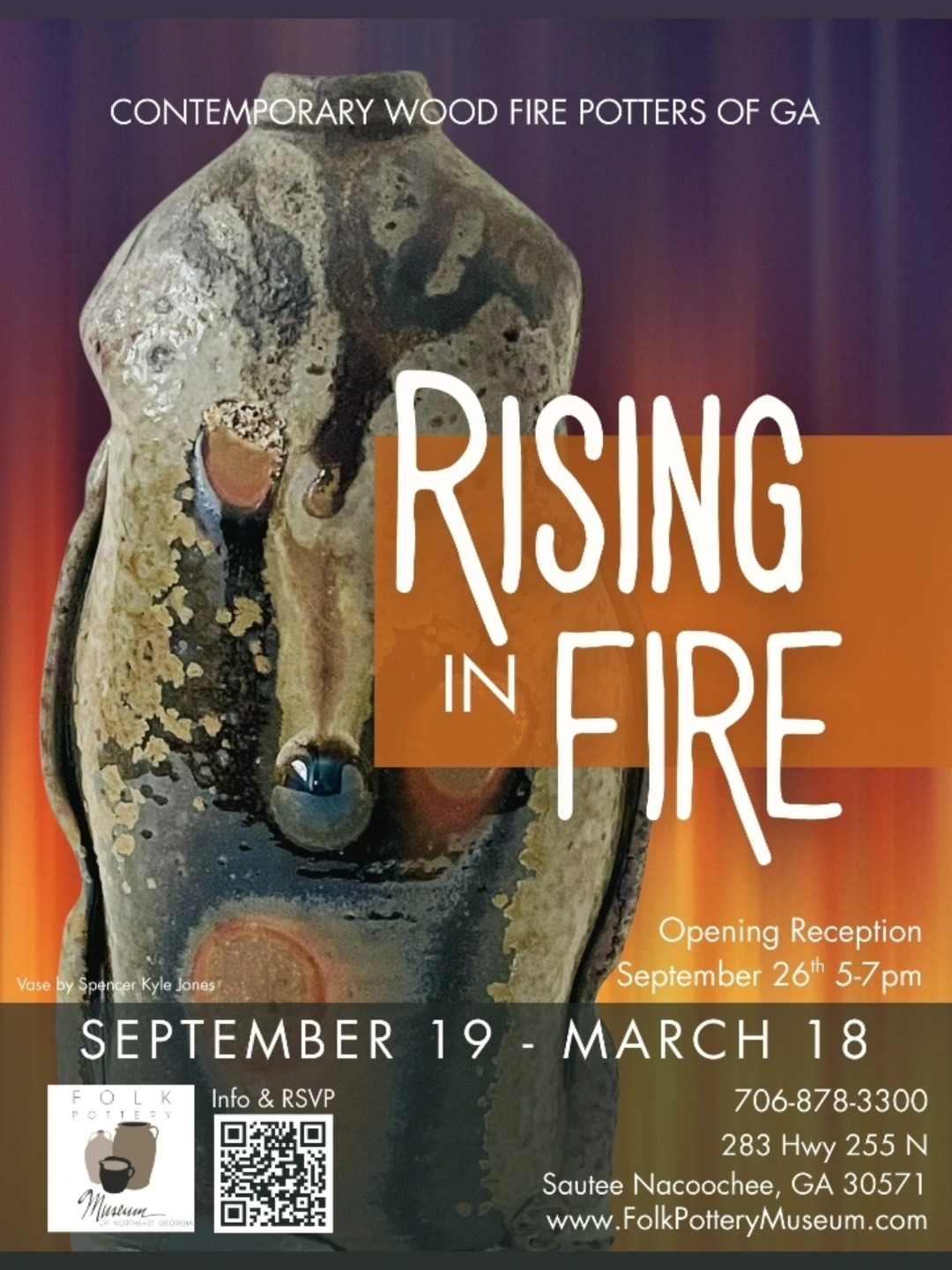
Don’t forget to come out for the “Contemporary Woodfire Potters of Georgia” exhibit at the Folk Pottery Museum of NE Ga in Sautee Nacochie. At the reception There were stories from legacy potters like Jon Brinley, Rebecca Wood, Stephen Hawks (Hunter Sneed ), Rick Berman, Roger Jamison & others. See you there! This was recorded and will be on the website soon.
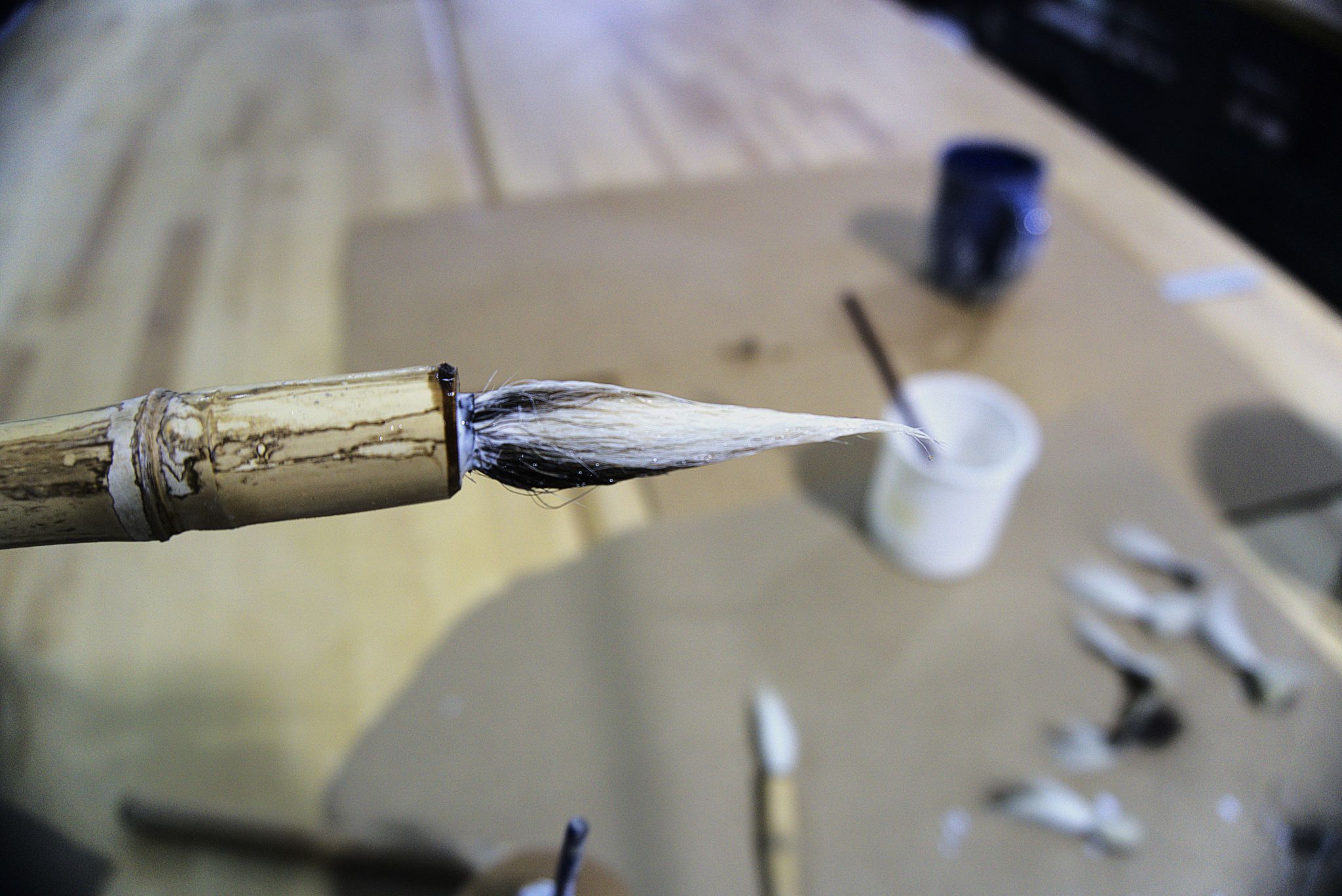
I did a mini workshop for my students on how to make Deer Tail Brushes and how to use them, 5/1/2025. The tails were from one of my work study students that has hunters in the family. I do try to honor the deer. The bamboo came from a path on campus.
A former student recently asked me: “Did you always want to be a potter? Or was it a following from your family? Or did you want to do something else?” This is my long answer:
My history in Art and Ceramics is hard to explain. I felt that art was and is my calling. For better or worse, I have seen it as a spiritual calling. Trying to make up my mind what form it would take has been one of the hardest dilemmas of my life. Any other time I would probably been a preacher, which is also in my family. I trained in theater but saw it as dangerous for my soul because of the lifestyle and the lack of control most actors have over their art, though I also have training in tech, directing, and playwriting. I also have a love of film, but editing was always too tedious, however rewarding. Music, never happened in the way I had hoped, though I still consider myself a musician. My friends were always technically better than me though I have a gift for improvisation as in other arts. Painting was and is a passion of mine. Pottery is grounded, like a good partner that balances me when otherwise I might be wayward. It is demanding but also rewarding. I thought at first I wanted to be a sculptor, but it takes real physical strength unless you do small work and It never was a practical solution for my life until recently. It has been easier to sell my pottery. Poetry is my secret life, the world and words, where everything comes to light, literature in general. I am all of these things but always fought my fears and my other major flaws which kept me stagnant spiritually and slowed my highest aspirations, an aspirant of higher spiritual consciousness, invested in this world that I love. This is only a glimpse.
More specifically, I felt that I knew more and had more training in pottery so It sort of took over my life. I had at least 5 formal teachers including my father. I saw countless other potters work from a very young age. The influence that the discussions I had with my brother-in-law about the craft made me think I had to prove something to myself. When I got the chance to wood fire, I took it. I had an old timer, D X Gordy, tell me I was a master around 30. My relationship with my father always made the choice problematic. It was not exactly my intention to do what he did. Even my eclecticism has something to do with him, though I did learn to cook and sew from my mother. I had at. countless direct and indirect influences, and I have read and studied extensively.
I do not think of myself as a potter’s potter, like Hamada, Cardew, or Mark Hewitt, but I am a potter none-the-less. I hope I have not been misguided in this.
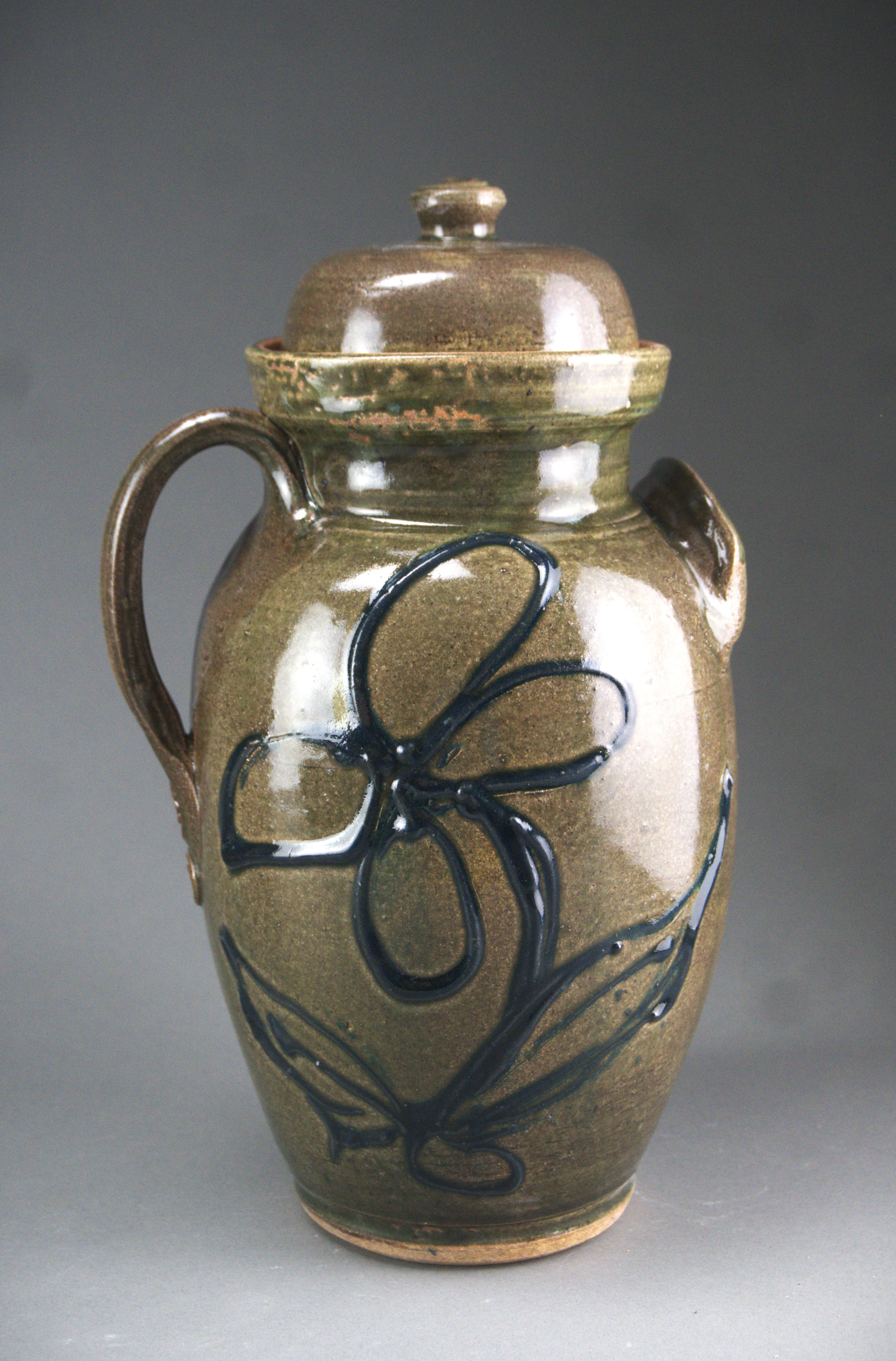
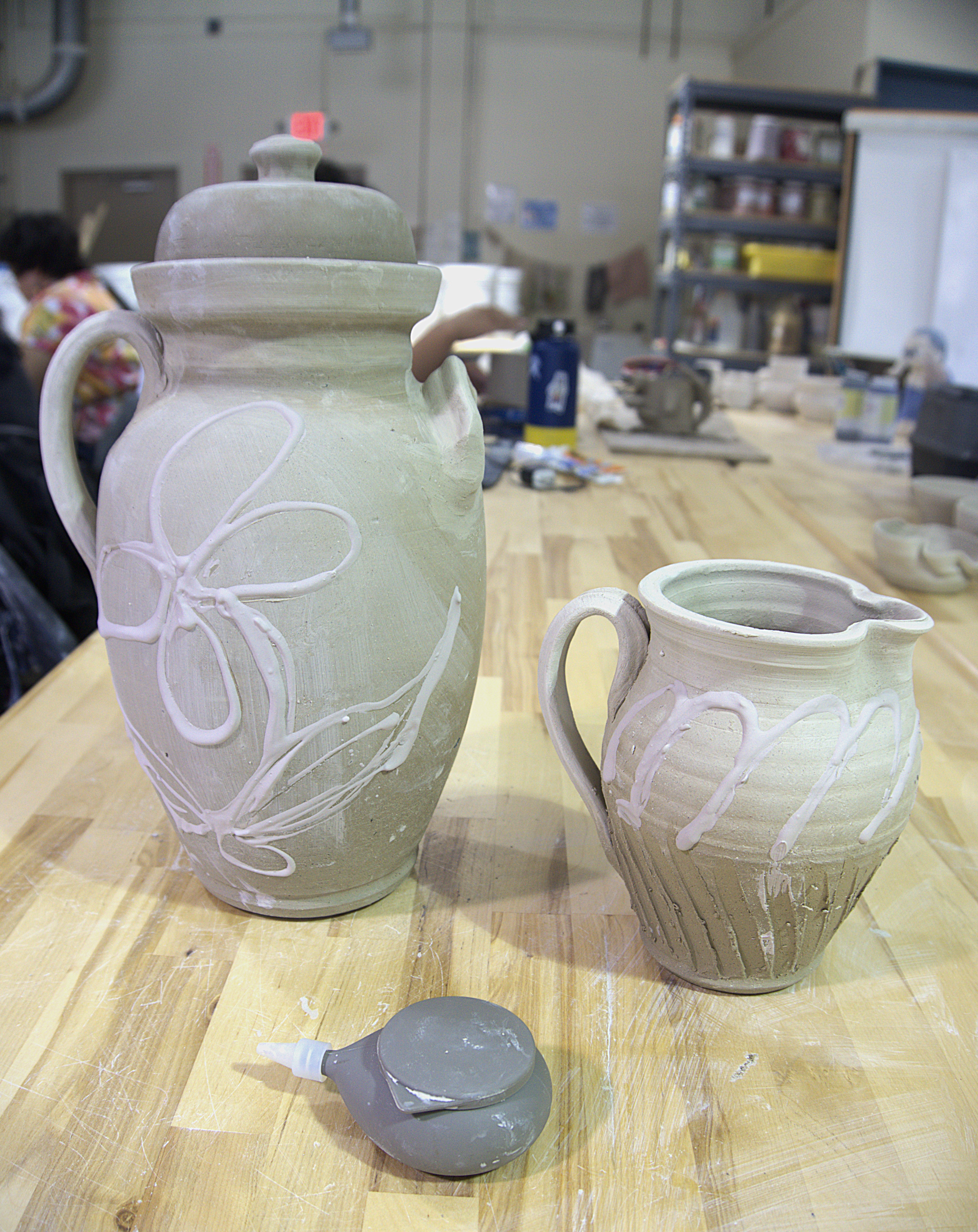
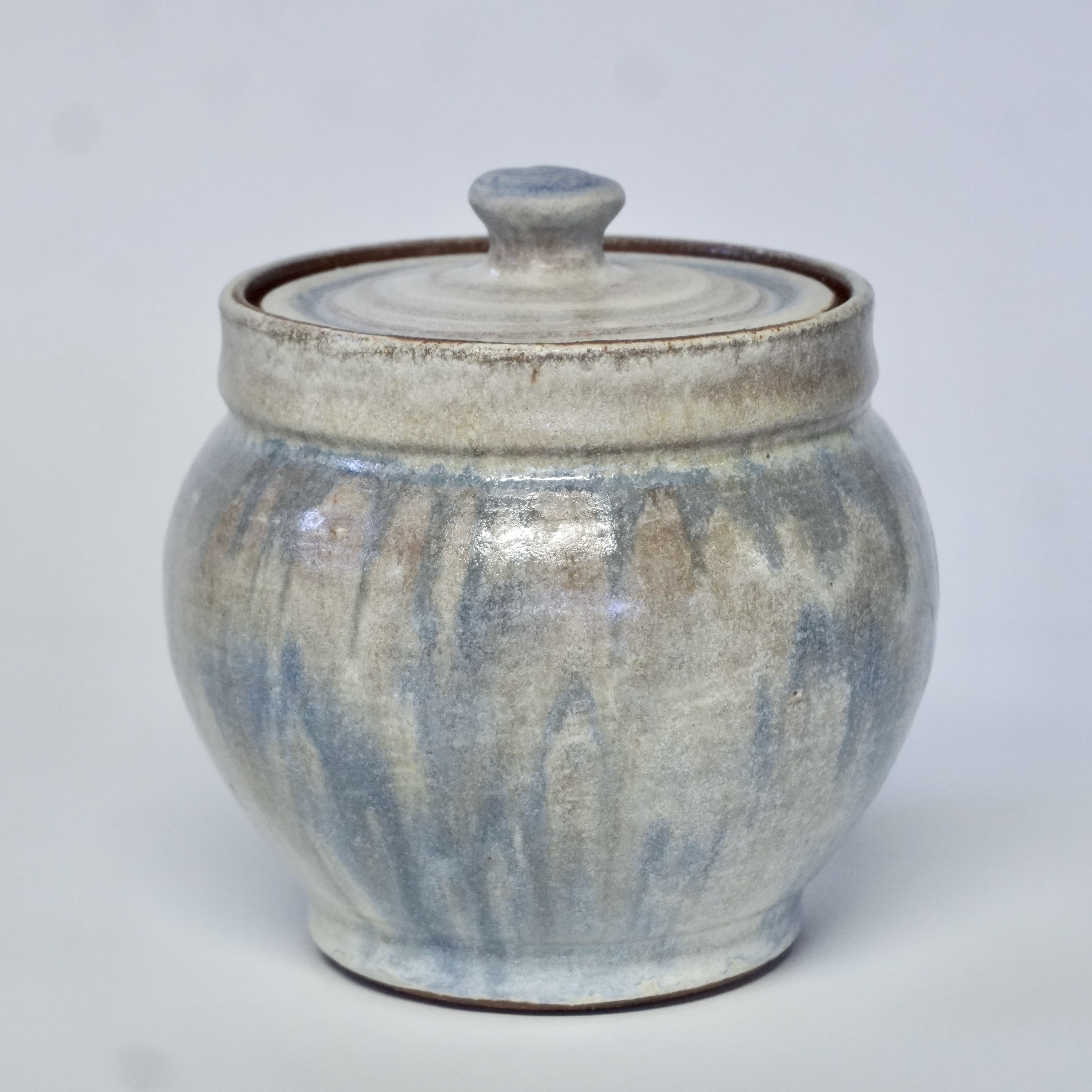
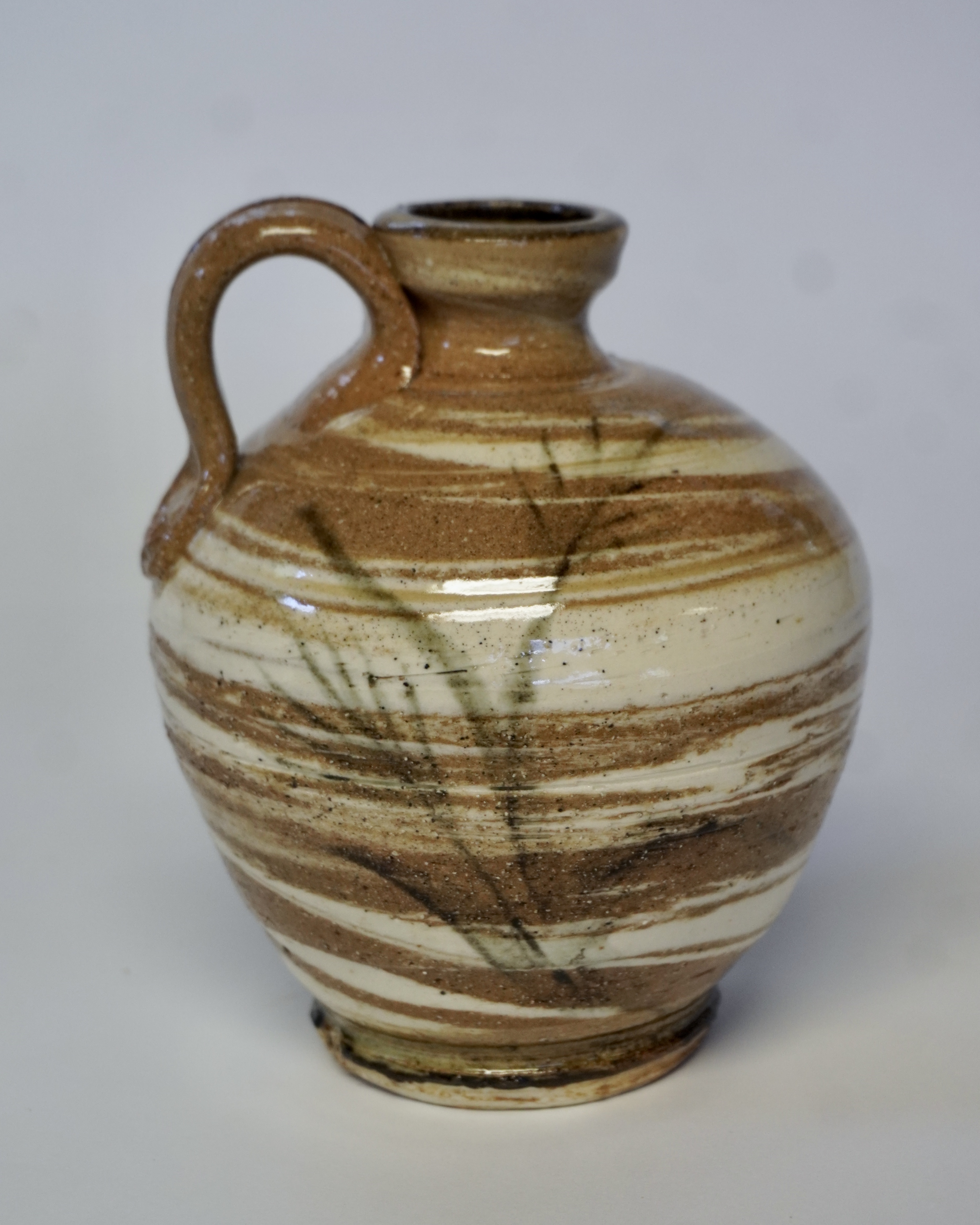
March 2025 I quit trying slip trailing until recently because I never found a tool that suited my practice. When a student asked me to demonstrate a traditional pickling jar, I thought it was the best candidate to test this cake decorating tool I got from HEB clearance. There is a doubled wall gally where the lid rests for a water seal. There is a small drain to be plugged with a piece of waxed wood. I got this from looking at a DX Gordy, large jar in the Westville pottery. The student showed me a contemporary version from the internet. I think this was around 8-10 lbs. The Gordy version probably took 25lbs, which is what I used to use to make churns and other larger pieces, close to my limit. I still used the collar technique for joining 2 wet parts which I learned also from DX when he revisited Westville.
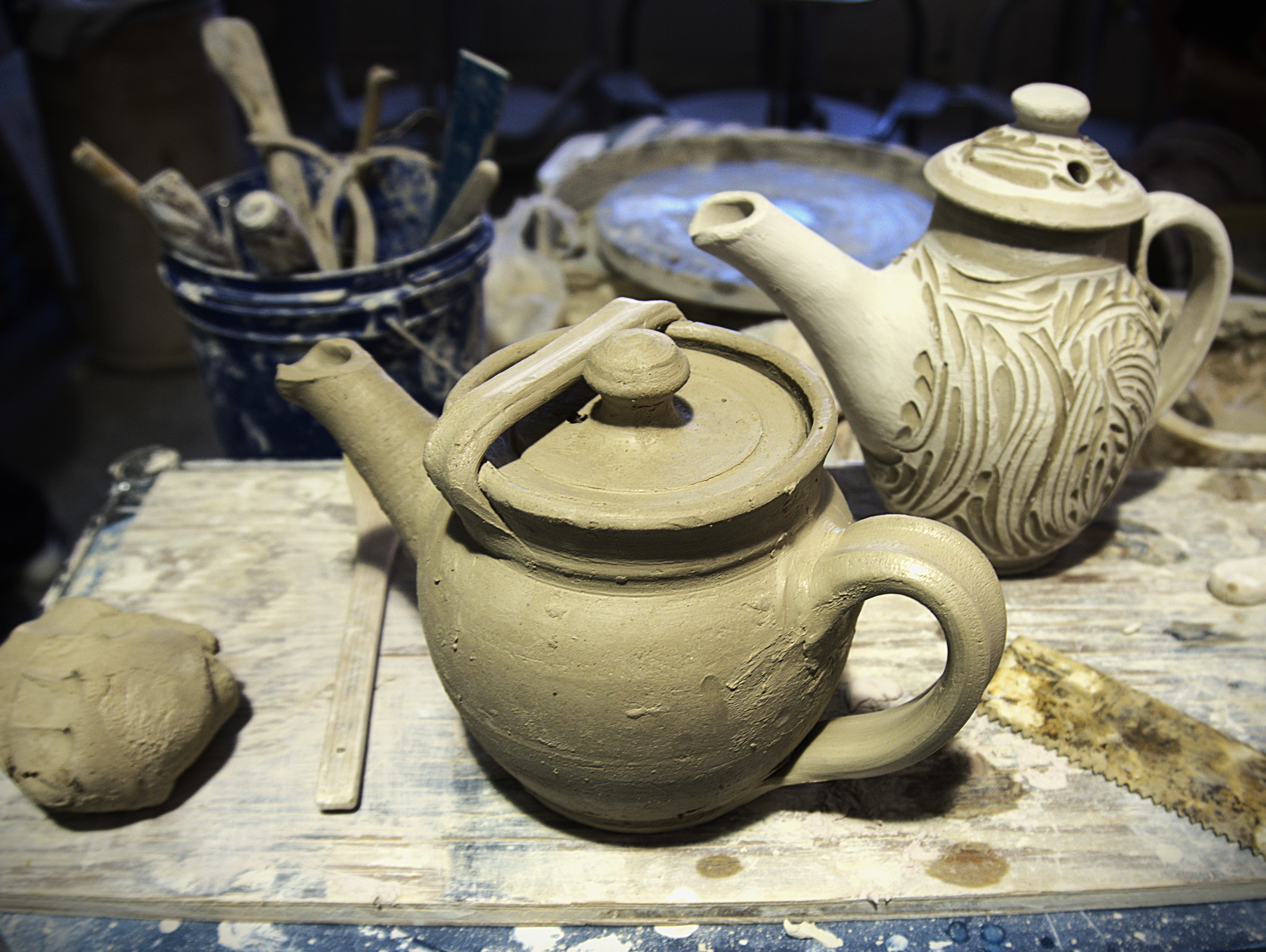
Some new teapots in Process: this is in the green-ware stage prior to smoothing out some of the surface blemishes from handling while putting the parts together. The wo types of lids are both thrown off the hump, one flat, one domed thrown upside-down with the knob added later. The domed lidded teapot is carved through white slip. To make a teapot work, I follow the steps in Michael Cardew’s Pioneer Potter book. My style is different but I try to make sure my teapots work. The domed one has a flange which catches when pouring. The strap catches the flat lid. March 2025
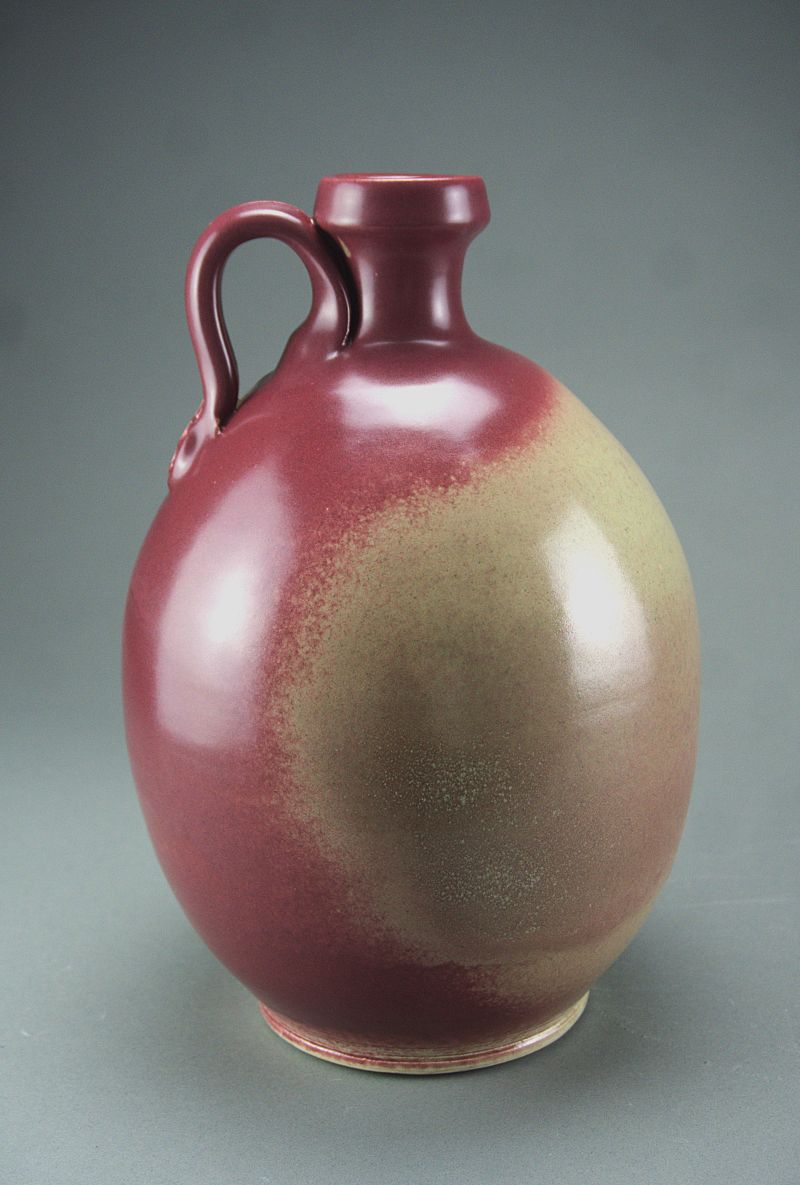
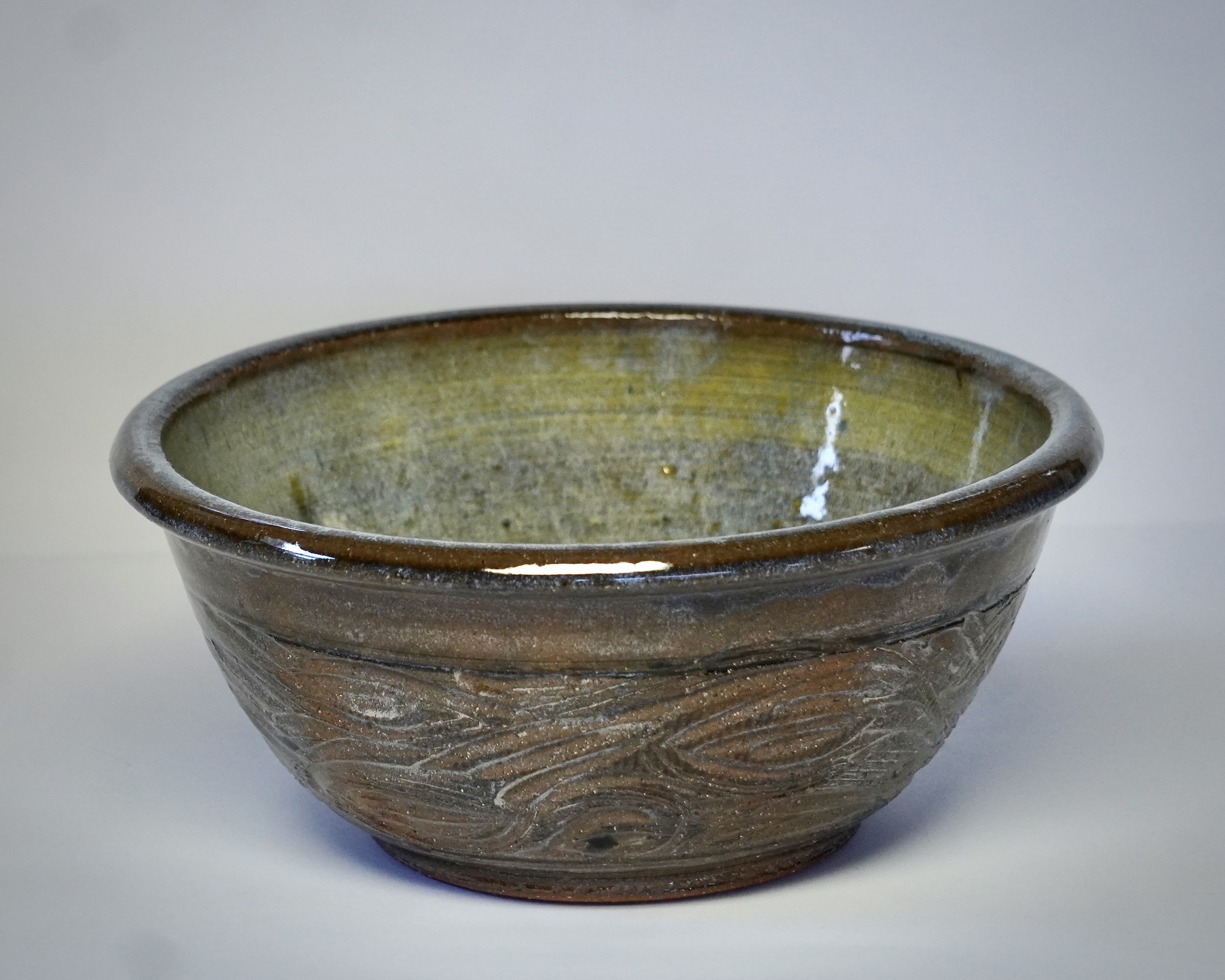
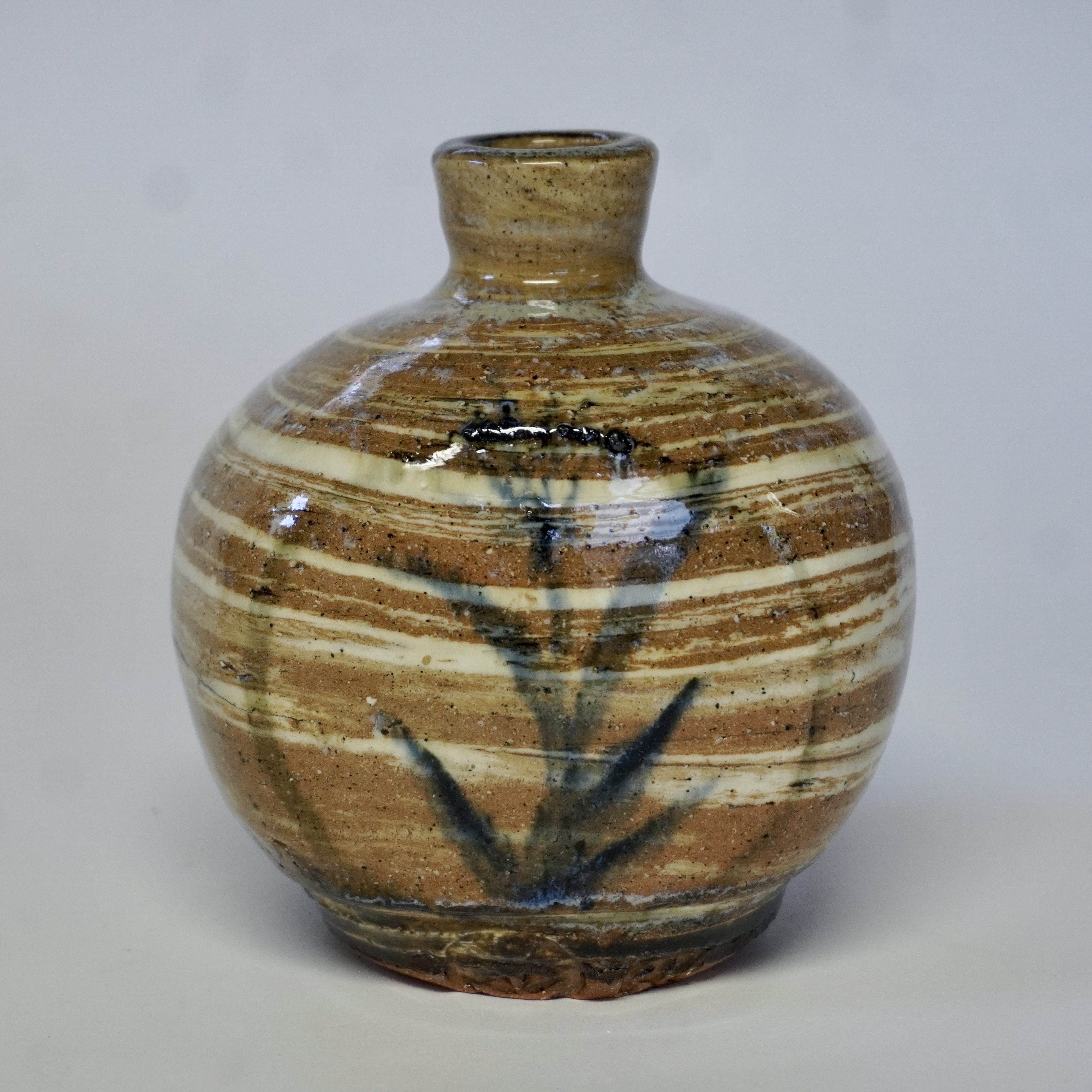
Porcelain Jug Cone 6 Gas Fired Reduction. December 6 Firing 2024 This is a jug from the most resent gas firing. It is a chrome/tin glaze that usually goes greenish celadon in reduction. This firing I held back on reduction because the last firing was over reduced so that there were spots in the kiln that fired like oxidation, thus the reddish color on one side.
American Idol and the Ineluctable evolution of the Cosmic Temple Form
Installation
2021-2023
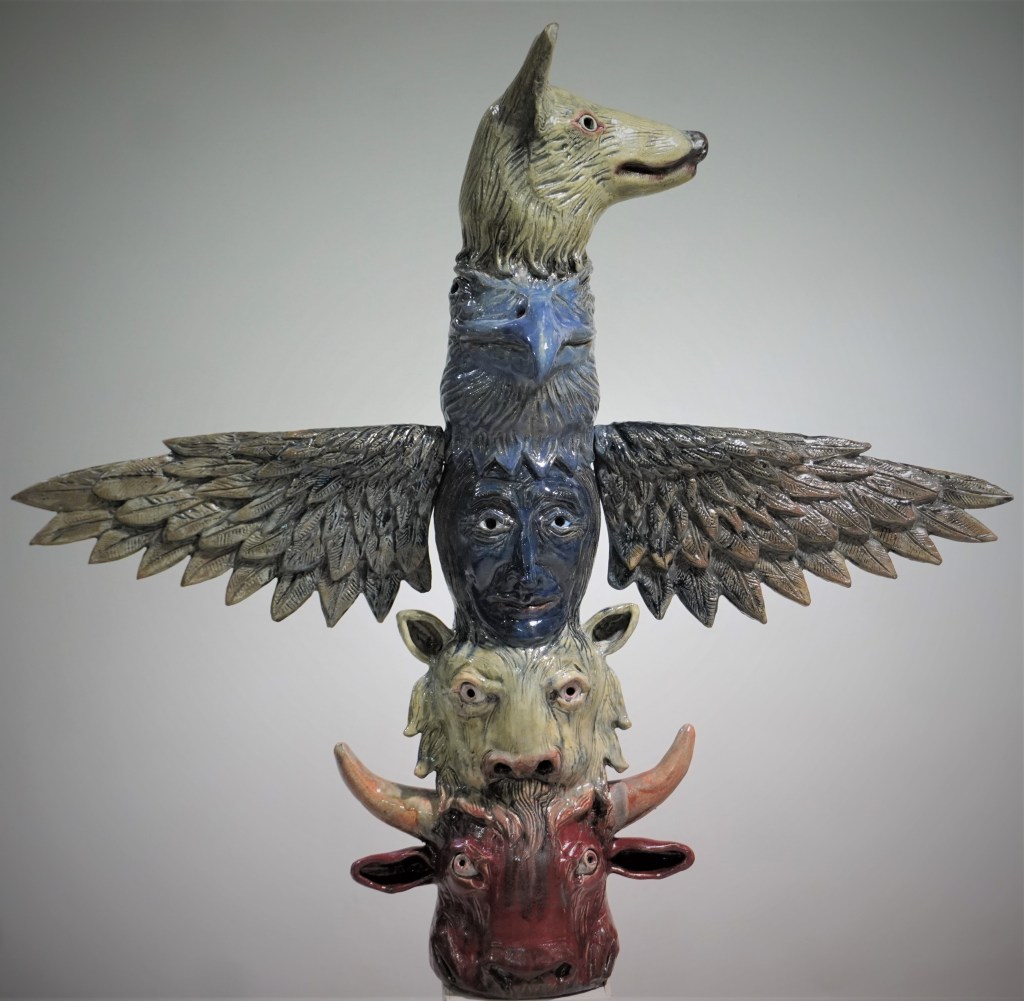
American Dream Totem, Ceramic
Altar/Hearth, Wood
Chalk Drawing on Black Paper
Jachin and Boaz Candle Holders, Ceramic
Worn Braided Rug by Catherine Hawks (artist’s mother), Hand and machine sewn, braided cloth
Dead tree branch
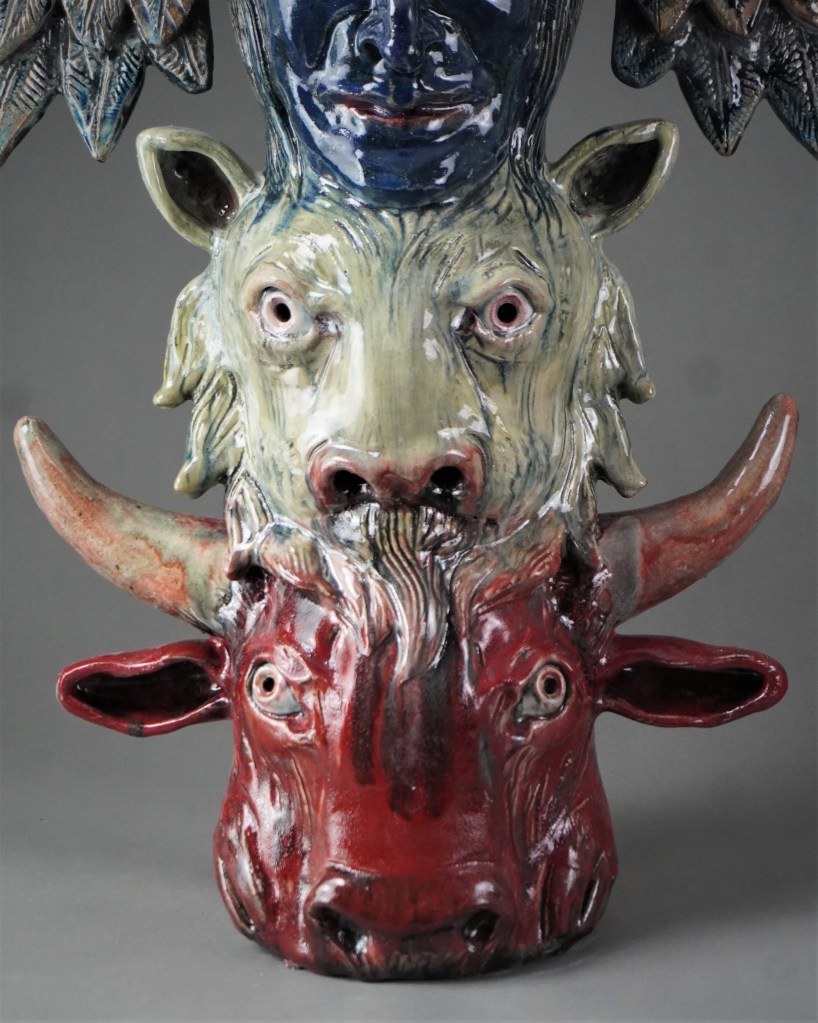
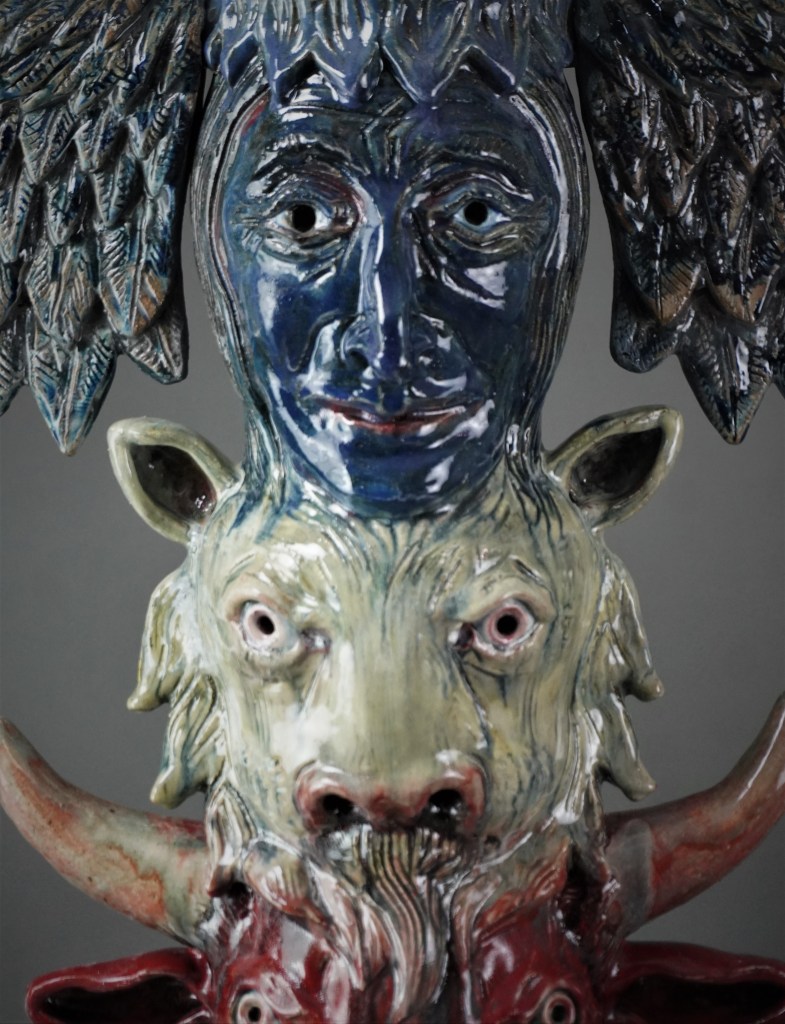
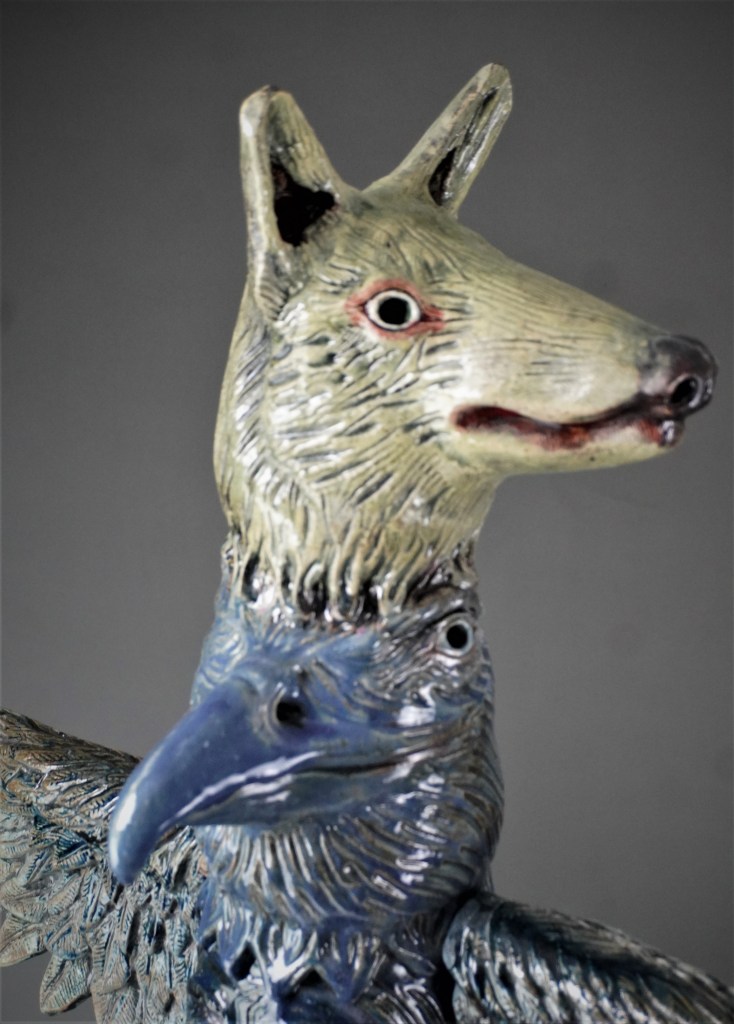
The installation is somewhat based on a dream I had at least 2 decades ago. It is an altar and a hearth with a totemic work incorporating the 4 seraphic beings, beings which surround the throne of God, also historically referred to as the 4 evangels representing Mathew, Mark, Luke, and John, and at the human level, the 4 temperaments, choleric, melancholic, phlegmatic, and sanguine, as well as a coyote, an American trickster being, standing in for Anubis, a spirit guide. This is flanked by 2 candle holders with candles, referencing the 2 columns/candles in Masonic Temples, Jachin, and Boaz. They are entwined by 2 monsters as described in Revelation rising from the land and water, representing the temptations of mind and body, the physical and the sensual, Lucifer and Ahriman (The Persian name for Satan). Written on the altar are the words “That Good May Become”, a quote from Rudolf Steiner’s Foundation Stone Meditation. There is a braided rug made by my mother in front of the altar, that personalizes the piece and reiterates the idea of hearth and home. Behind the piece is a large chalk drawing on black paper of a minimalist representation of an American gothic country church floating in the stars with the tunnel of light from near death experiences above and to the right.
It is, like all altars, indicative of a gateway to the spirit world. It is called an Elegy because it is meant to evoke an experience of great loss (but also potential) in the face of great temptations placed before America at the threshold of consciousness, in the wake of any unifying spirituality or culture, whether Indigenous, European, or otherwise. There is also intended, an echo of the Great Awakening of the late 19th century within the work, to include the acknowledgement of Earth’s sacrifice and a renewed reverence and consecration towards Earth and Cosmos.
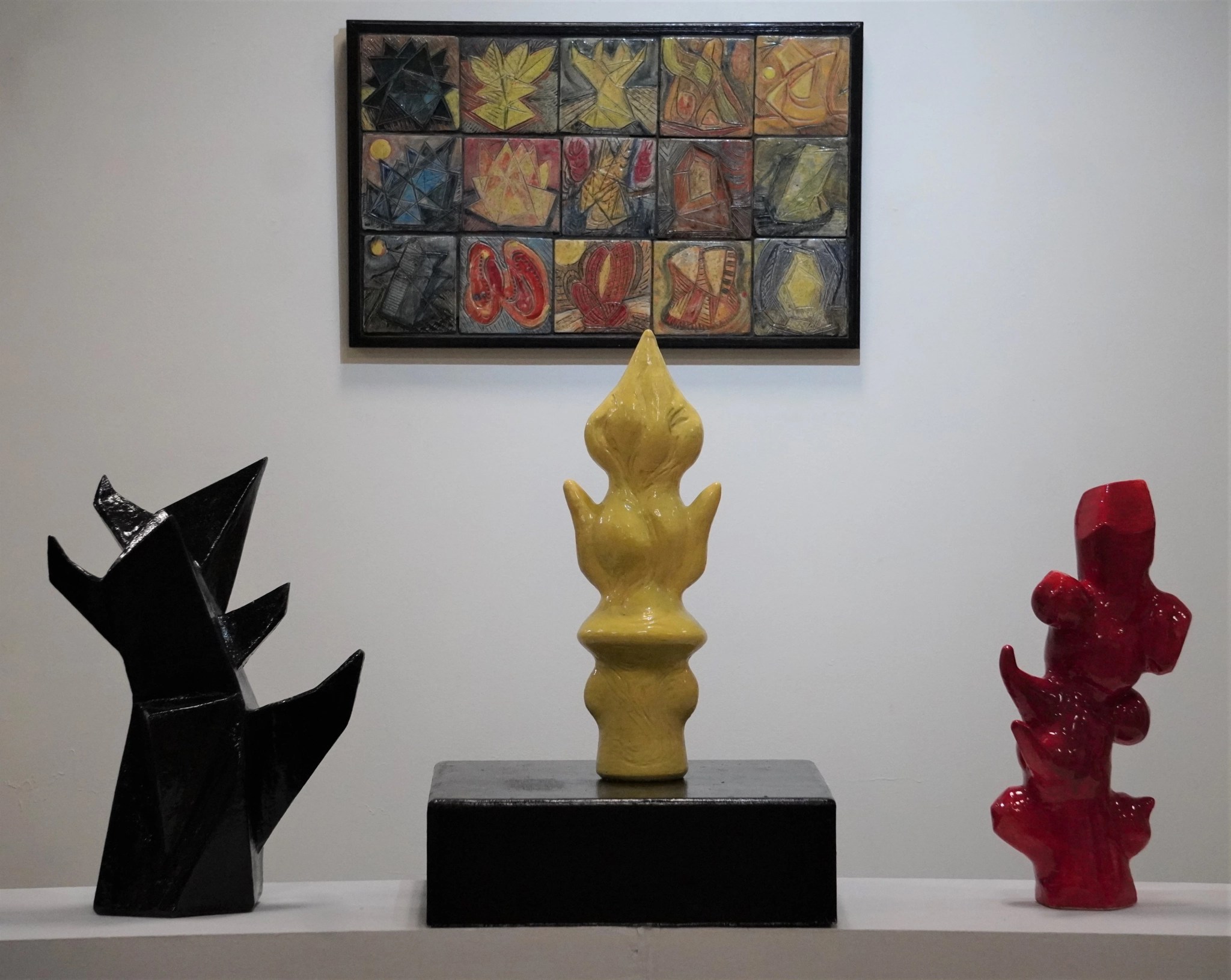
One of the characteristics of my art practice, is eclecticism. My current ceramic works represent two or more directions. One, a longstanding investigation of form and color, another, more recent, the use of fired on printed laser jet decals. Both directions assume a type of visual, philosophical, and spiritual dialectic, one of form and color, the other of image, form, and text. They both constitute a type of visual language. which, over time has helped me to clarify certain fundamental laws manifested in nature and spirit. The decal works, allow me to expand my 2D practice of appropriating images, often my own, and using them like language in concert with form sculptures, my own poetry, and other text.
My sculptural work involves the relationship of color to form; the relationship of form to will, thought and feeling; and the paradoxical nature of ideal form vs form in relation to decay, metamorphosis, and becoming. All of this is further taken out of the abstract by my consciously relating form to anthropomorphic ascendancy and the nature of wounding and, consequential, transcendent healing processes. This brings me back to a more intimate relationship to materials, indicative of my expressive and conceptual intent.
I have been working with a threefold (will, thought, feeling) view of form and color for many years. However, since I am known more as a potter I have given the formative years of my career predominately to the development of specific processes and forms related to functional ceramic. I am still a practicing potter, grounded in the world traditions of utilitarian wares, with an art practice reflective of a life steeped in traditional, modernist, and contemporary, functional pottery.
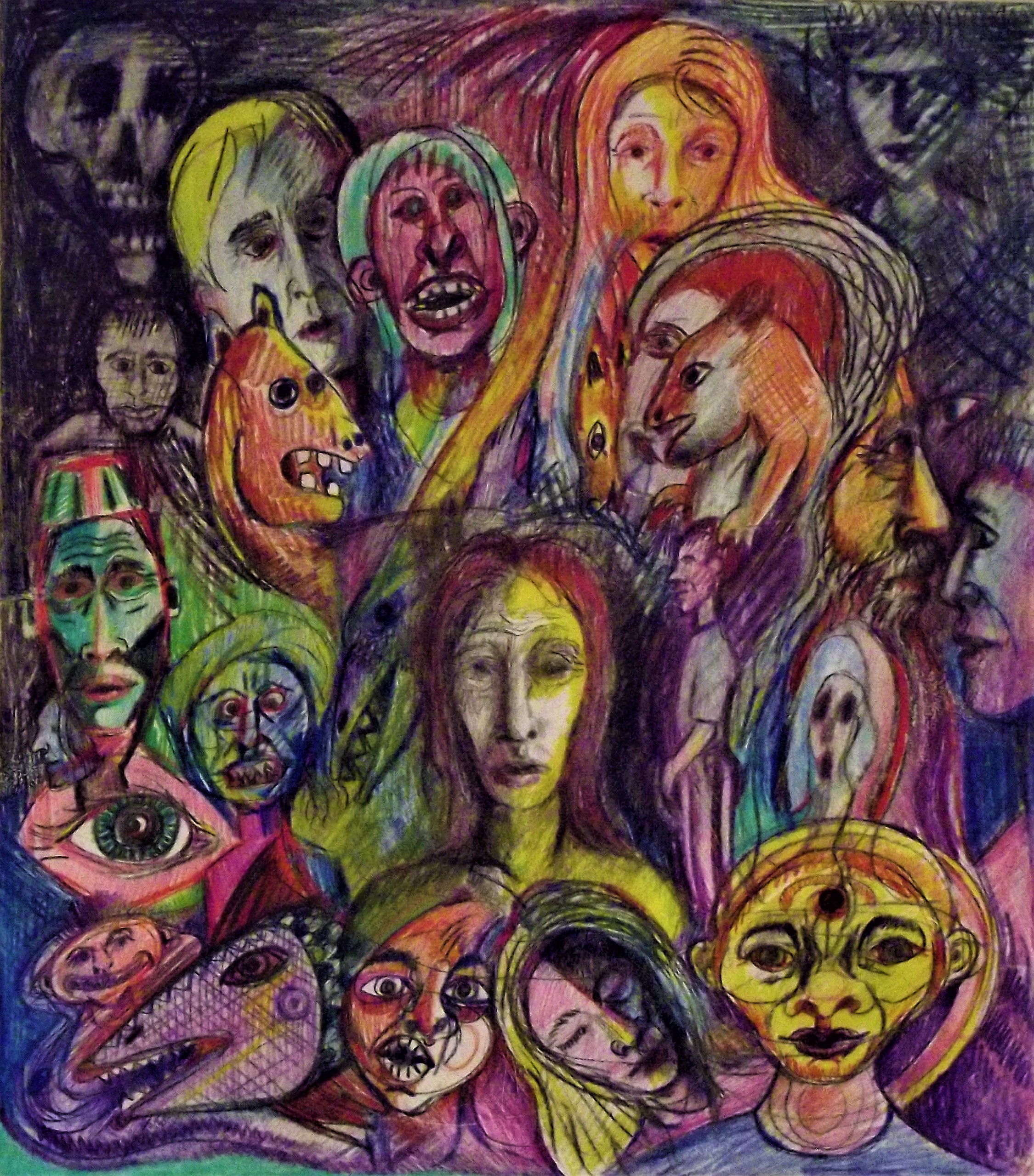
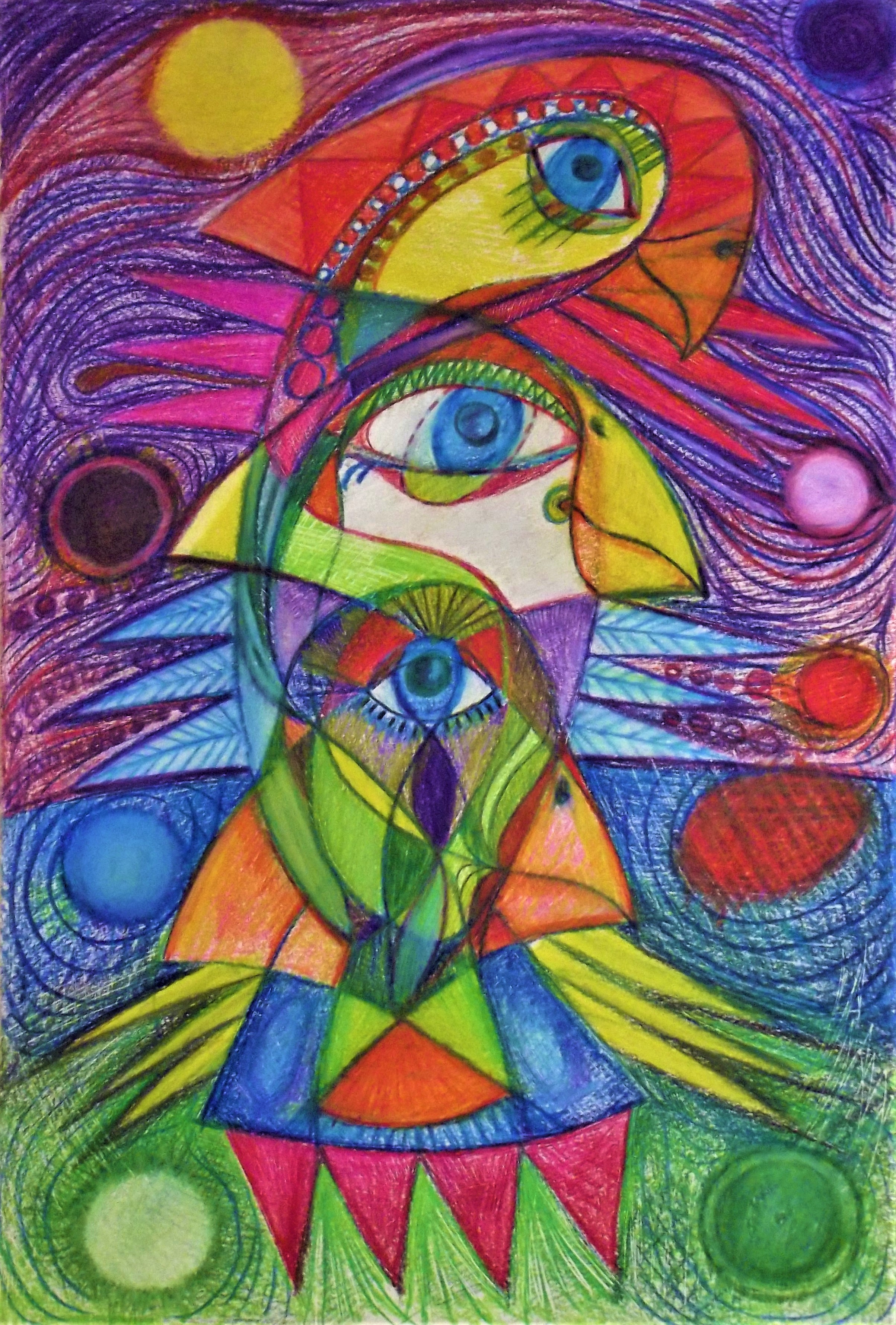
Recently I have been doing a series of drawings using colored pencils. This is not new to my overall practice. Since childhood, I have done paintings, drawings, and collage right along with my 3D practice. These drawings contain both figurative elements, as well as non-objective and abstracted elements, the unifying theme being my relationship and use of color as an integrative spiritual experience. These drawings, done since August of 2020, I call my “Insomnia Drawings”, having mostly been done late at night when I have trouble sleeping. They are often improvisational and altogether have the characteristic of collaborative creation with unseen worlds, manifesting inner and outer consciousness. Some of these works are also finding their way into my ceramic practice with the decal prints, color also being a unifying force between 2D and 3D.
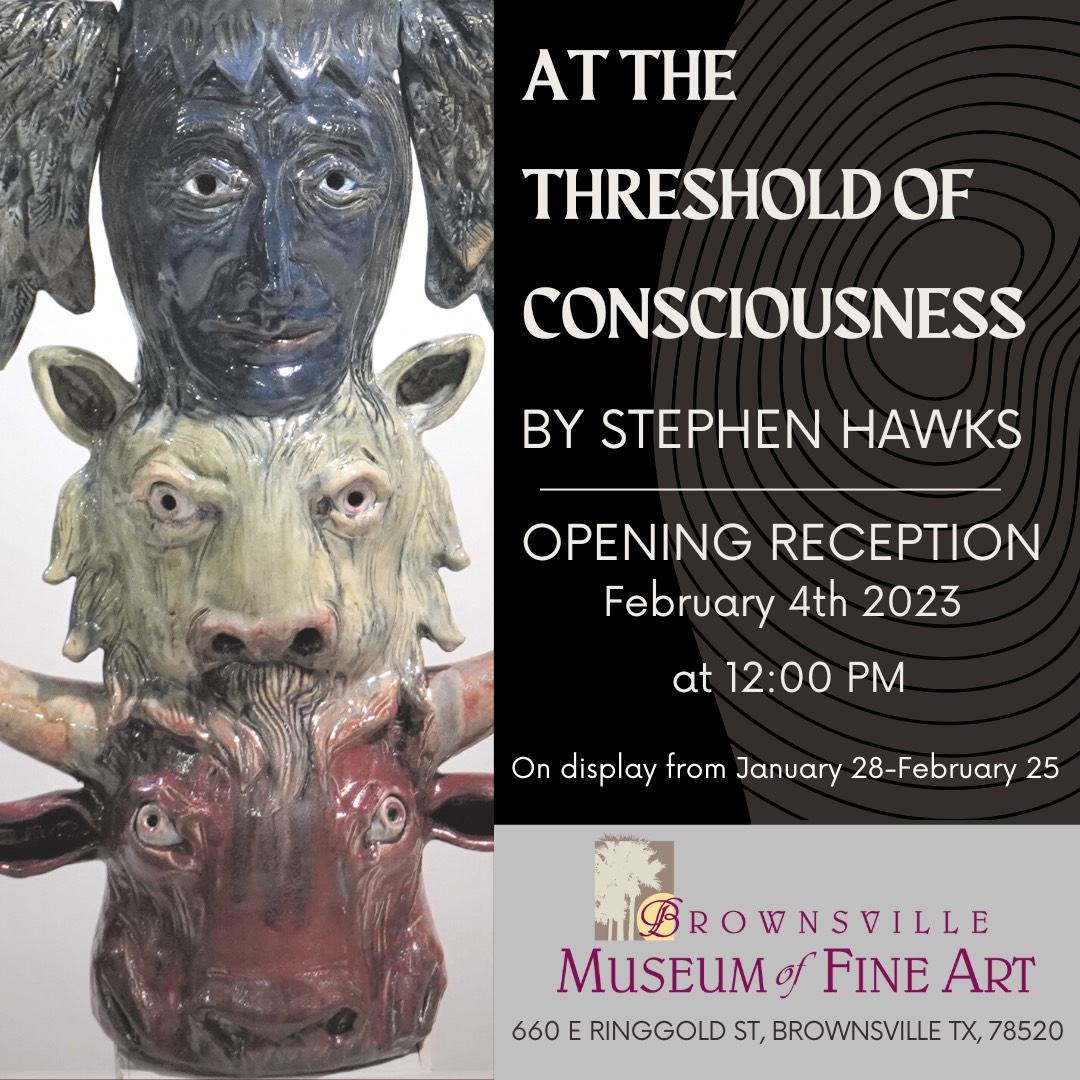
In addition, I have done some complex expressionistic totemic works that figure prominently in this exhibit. The idea for the Installation, Elegy for the American Dream, which is the last in a long series of totemic works incorporating the four Seraphim, has been with me for several decades. The Seraphim are also known as the four evangels at the level of human group souls, related to the four gospels in Christian iconography. The arrangement as a totem was suggested to me by a drawing of Rudolf Steiner.. I have often returned to the idea and was finally able to dedicate time to creating this work, the kernel of which came to me in a dream. I have pondered over it ever since and drawn images of it for years, trying to piece together its meaning(s). The current amalgamation is a composite, partly from the dream and partly from my interpretations.
Description of Instalation:
Elegy for An American Dream, Installation 2021-2023:
American Dream Totem, Ceramic
Altar, Wood
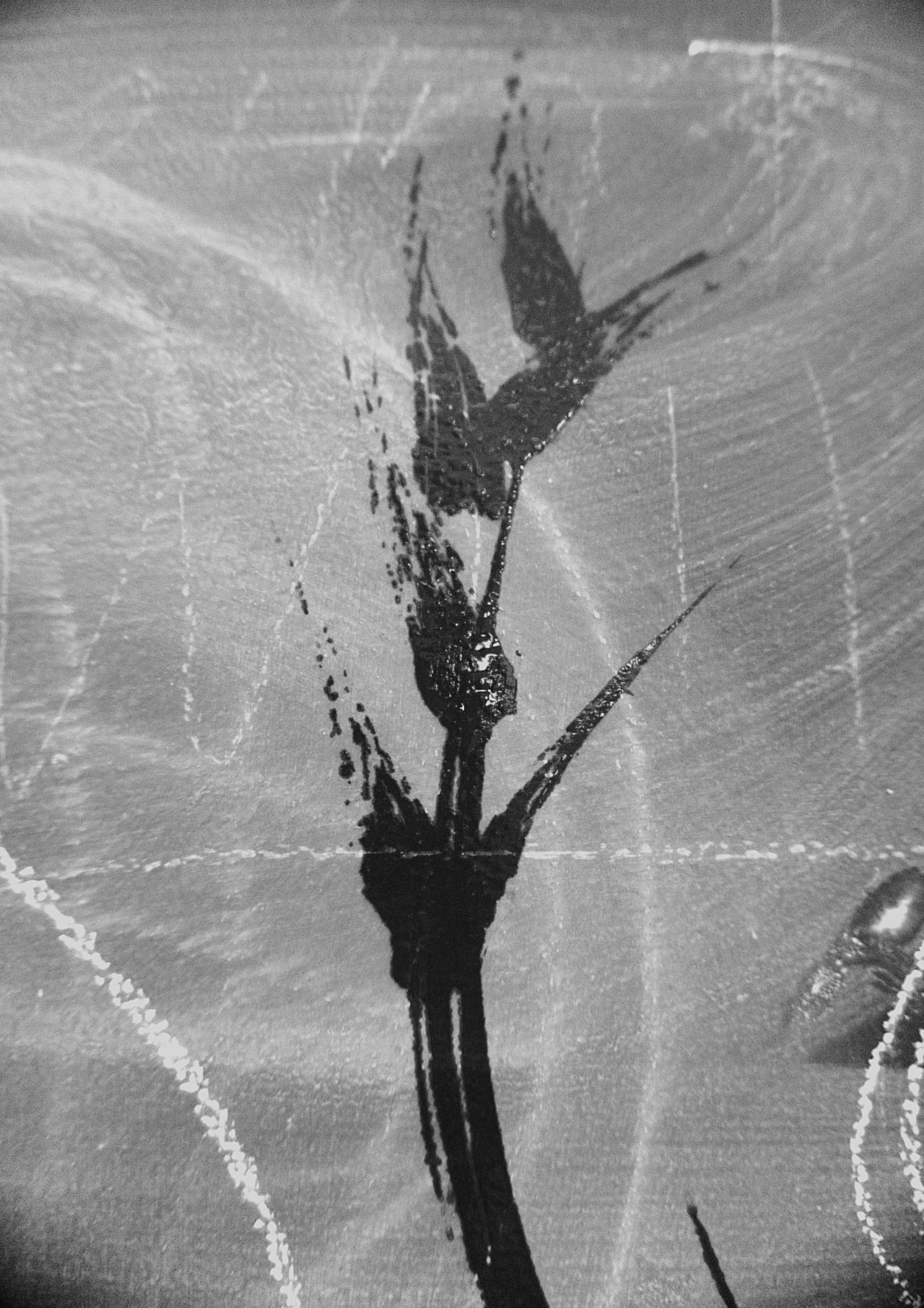
Chalk Drawing on Black Paper
Jachin and Boaz Candle Holders, Ceramic
Chalk on Black Paper
Worn Braided Rug by Catherine Hawks (artist’s mother), Hand and machine sewn, braided cloth
The installation is somewhat based on a dream I had at least 2 decades ago. It is an altar and a hearth with a totemic work incorporating the 4 seraphic beings as well as a coyote, an American trickster being, standing in for Anubis, a spirit guide. This is flanked by 2 candle holders with candles, referencing the 2 candles in Masonic Temples, Jachin and Boaz, They are entwined by 2 monsters as described in Revelation rising up from the land and water, representing the temptations of mind and body, the physical and the sensual, Lucifer and Ahriman (The Persian name for Satan). Written on the altar are the words “That Good May Become”, a quote from Rudolf Steiner’s Foundation Stone Meditation. There is a braided rug made by my mother in front of the altar, that personalizes the piece and reiterates the idea of hearth and home. Behind the piece is a large chalk drawing on black paper of a minimalist representation of an American gothic country church floating in the stars with the tunnel of light from near death experiences above and to the right. Beside this are 4 ceramic platters, 2 on either side, with images of the seraphic beings again, also historically referred to as the 4 evangels representing Mathew, Mark, Luke, and John.
It is, as all altars, indicative of a gateway to the spirit world. It is called an Elegy because it is meant to evoke an experience of great loss (but also potential) in the face of great temptations placed before America at the threshold of consciousness, in the wake of any unifying spirituality or culture, whether Indigenous,European, or otherwise. There is also intended, an echo of the Great Revival of the late 19th century within the work.
BIOGRAPHY:
Stephen Hawks, MFA
Lecturer III UTRGV, School of Art and Design
Stephen Hawks, born in Washington D. C., has lived most of his life in Georgia. He has training in art, music, and theater, an AA in theater from South Georgia College, a BFA from Valdosta State University, and an Interdisciplinary MFA, with a concentration in ceramics from Florida State University with additional coarse work in art education from Columbus State University. He was Resident Potter at Westville living history museum for 19 years and an independent artist for over 35 years. He is married with two grown Daughters. He came to Brownsville Texas in the fall of 2012 to teach at UTB, courses in Ceramics, Graduate Art Ed, Art History, 3D Design, and Art Appreciation. Currently, he oversees the Ceramics Program and teaches Ceramics and Foundations in the School of Art and Design at The University of Texas Rio Grande Valley on the Brownsville Campus. Stephen Hawks is also a poet and musician. He invites collaboration across disciplines and supports this in his art and educational practice.






















 Stephen Hawks - Artist